For many companies, importing infrastructure equipment into Brazil looks simple on paper. Purchase the hardware, ship it internationally, clear customs, deploy it, and move on.

How IT Hardware Imports Work in Brazil
Learn how IT hardware imports work in Brazil, including ANATEL requirements, customs clearance, documentation, deployment risks, and lifecycle planning for infrastructure teams.


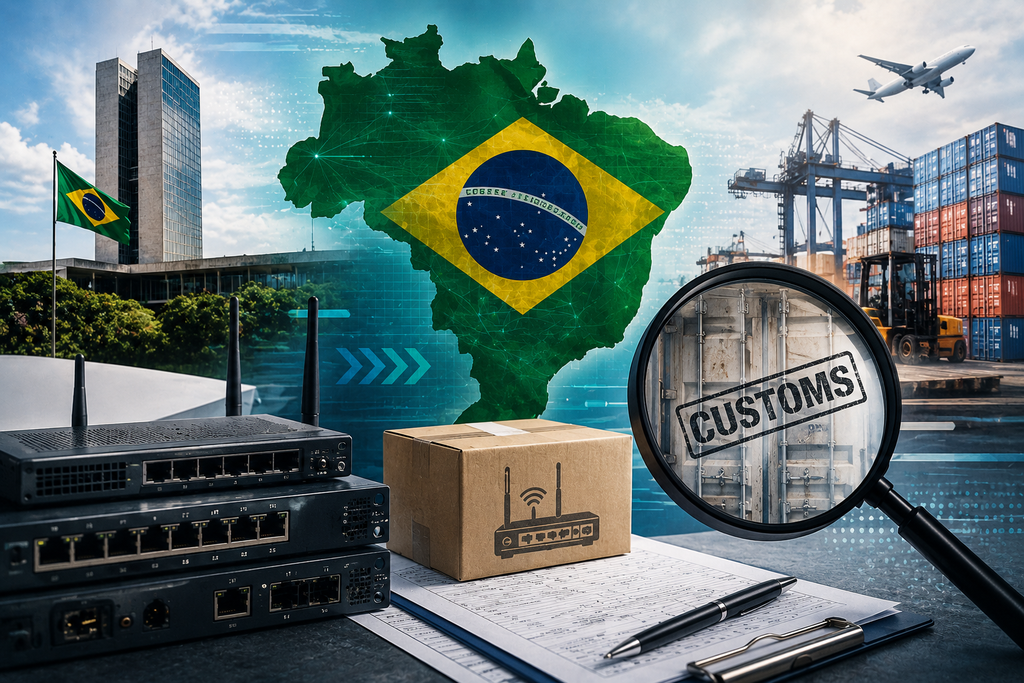
How IT Hardware Imports Work in Brazil
By Daniela
GET ACCESS TO A CUSTOMIZED SUPPLY CHAIN FOR YOUR TECH EQUIPMENT
Check out our exclusive offers and updates!
In reality, tech equipment import in Brazil involves multiple operational stages where small mistakes can create major deployment delays. The challenge is not only transportation. It is coordinating procurement, compliance, customs, deployment readiness, and lifecycle visibility before the hardware ever arrives in-country.
Understanding the process step by step helps infrastructure teams reduce delays and avoid costly rollout disruptions.
Step 1: Procurement and Hardware Planning
Most Brazil deployment problems begin during procurement, not customs.
When infrastructure teams purchase routers, firewalls, switches, SD WAN appliances, servers, or wireless devices, they often focus on availability and deployment timelines while overlooking Brazil-specific import requirements.
This becomes especially important when importing routers into Brazil because networking and communications equipment may fall under additional regulatory review.
At this stage, companies should already be evaluating:
- product classifications
- importer requirements
- local entity coordination
- compliance risks
- deployment timelines
- end-of-life planning
One of the biggest operational mistakes is purchasing hardware first and trying to solve compliance later.
Step 2: ANATEL Review and Regulatory Validation
Before certain network and telecommunications devices can legally enter Brazil, companies may need to review ANATEL import requirements.
ANATEL, Brazil’s National Telecommunications Agency, regulates many communications and networking products entering the country. Depending on the device type, hardware may require:
- certification
- homologation
- technical approval
- local compliance validation
This is one of the most overlooked parts of Brazil telecom customs clearance.
Many infrastructure teams only discover ANATEL after the equipment has already arrived in-country, which is one of the main reasons deployments become delayed unexpectedly.
According to the International Trade Administration, Brazil maintains strict technical regulations and import controls for telecommunications and technology equipment.
For companies scaling infrastructure globally, waiting until customs to identify compliance problems can create serious operational bottlenecks.
Step 3: Documentation and Import Preparation
Once hardware compliance is validated, the next challenge becomes documentation accuracy.
Brazil customs authorities closely review:
- invoices
- serial numbers
- HS classifications
- product descriptions
- importer information
- declared values
Even small inconsistencies can trigger customs reviews or shipment holds.
Infrastructure hardware is especially sensitive because generic descriptions are often not accepted for networking or communications equipment. Teams handling tech equipment import Brazil operations often discover that vague documentation creates significant delays during customs clearance.
Brazil’s Federal Revenue Service outlines detailed customs and import procedures that directly impact technology infrastructure shipments.
Experienced infrastructure operators usually spend significant time validating documentation before the hardware ever ships because correcting errors after arrival becomes much more difficult.
Step 4: Customs Clearance and In-Country Coordination
Once the shipment lands in Brazil, customs clearance officially begins.
At this stage, authorities may:
- inspect hardware
- review classifications
- verify importer records
- evaluate compliance documents
- request additional information
For many companies, this becomes the first visible sign that the deployment is at risk.
A shipment arriving in-country does not mean the deployment is operationally safe. Infrastructure teams dealing with Brazil telecom customs clearance operations often discover that customs clearance itself becomes one of the most sensitive stages of the rollout.
Delays here can immediately affect:
- installation schedules
- engineering coordination
- client onboarding
- regional rollout plans
- deployment continuity
This becomes even more difficult when companies are coordinating deployments across multiple countries simultaneously.
Get customs clearance without delays to Brazil
Step 5: Deployment, Visibility, and Operational Control
Once hardware clears customs, companies still need to manage deployment readiness.
This includes:
- local transportation
- inventory visibility
- site coordination
- engineering scheduling
- deployment tracking
- replacement planning
This is where organizations begin realizing the difference between moving hardware and managing infrastructure operations.
Many deployment failures happen after customs because operational coordination breaks down between vendors, deployment teams, warehouses, and local support teams.
Successful deployments require visibility across the full infrastructure operation, not just shipment tracking.
Step 6: Reverse Logistics and End of Life Management
The lifecycle does not end after deployment.
Infrastructure teams also need to plan for:
- failed hardware returns
- replacement equipment
- redeployment projects
- decommissioned devices
- secure disposal
- asset recovery
Brazil has environmental and electronic waste regulations that can impact end-of-life hardware management. Companies handling equipment disposal or recovery operations should also review Brazil’s National Solid Waste Policy, which establishes rules around waste management and environmental responsibility.
For global infrastructure operators, reverse logistics and lifecycle planning become critical as deployments scale across multiple regions.
Recycle IT hardware at no cost with us
Why Lifecycle Coordination Matters
This is where companies begin separating freight movement from true infrastructure operations support.
Successful Brazil deployments require coordination across procurement, compliance, customs, deployment readiness, visibility, reverse logistics, and end-of-life management.
At Dragon Sino, the focus is not simply transporting equipment into difficult markets. The goal is helping infrastructure teams maintain deployment continuity across the entire hardware lifecycle, especially in regions where operational complexity can quickly disrupt rollout timelines.
That becomes especially important in countries many providers hesitate to support operationally. Brazil remains one of the most important infrastructure growth markets globally, but also one of the most operationally demanding.
The companies that consistently succeed are usually the ones preparing for operational complexity before the hardware ever ships.
Get a quote within 48 hours and deploy where most providers hesitate.
Share Article
Move IT equipment door to door ANYWHERE ANYTIME
Dragon Sino helps IT companies, SD-WAN providers, and data centers move equipment worldwide. With DDP, EOR, and IOR services, we handle customs and logistics for smooth, delay-free deliveries.