Many companies only realize the complexity of Brazil deployments after the rollout begins breaking down.

What to Look For in a Brazil IT Hardware Logistics Partner
Learn what to look for in a Brazil IT hardware logistics partner, from customs expertise and deployment visibility to lifecycle support and infrastructure coordination.


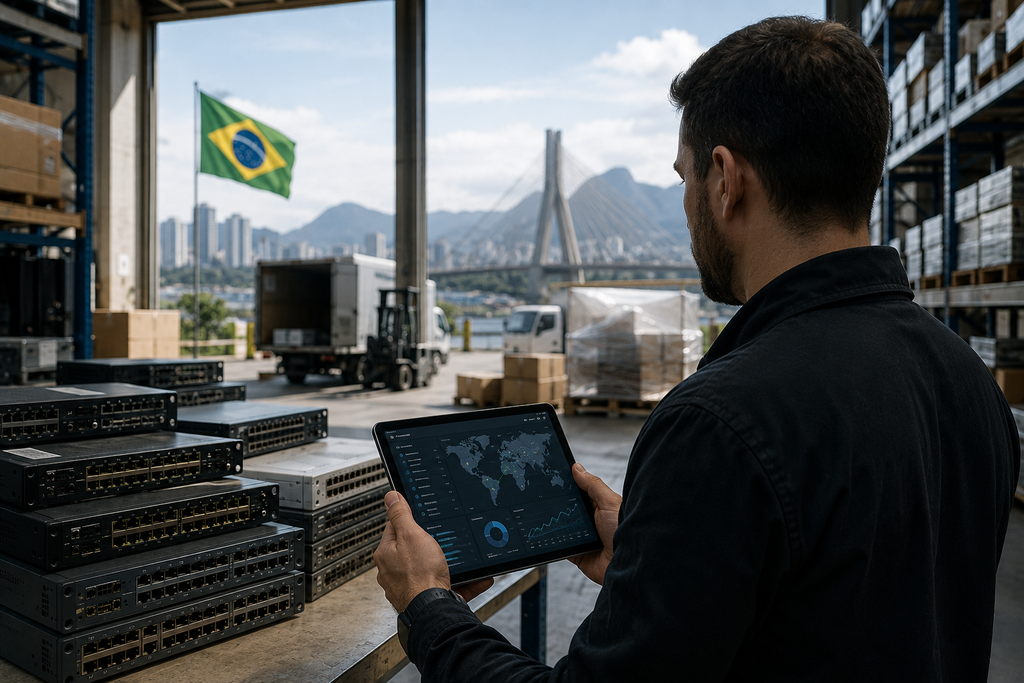
What to Look For in a Brazil IT Hardware Logistics Partner
By Daniela
GET ACCESS TO A CUSTOMIZED SUPPLY CHAIN FOR YOUR TECH EQUIPMENT
Check out our exclusive offers and updates!
The shipment landed. The hardware arrived in-country. Tracking shows movement. But installation schedules are slipping, customs reviews are slowing progress, and deployment teams are losing visibility into what happens next.
This is where infrastructure teams begin understanding the difference between standard freight providers and experienced operational partners.
Managing IT hardware logistics in Brazil is not simply about moving equipment from one location to another. It involves coordinating customs requirements, deployment readiness, local operational support, infrastructure timelines, and lifecycle visibility across the entire operation.
That becomes especially important for companies deploying:
- SD WAN infrastructure
- routers and switches
- wireless equipment
- servers
- telecom hardware
- multi-site infrastructure projects
1. Experience With Brazil Regulations Matters
One of the first things companies should evaluate is whether the provider actually understands Brazil’s import environment.
Brazil maintains strict customs and telecommunications regulations for technology equipment entering the country. Infrastructure teams managing network equipment logistics in Brazil often discover that providers without operational experience in the region struggle with:
ANATEL-related requirements
- importer coordination
- documentation accuracy
- customs classifications
- deployment scheduling
- infrastructure visibility
A provider unfamiliar with Brazil may move the shipment successfully while still creating delays during customs clearance or deployment coordination.
For networking and communications equipment, understanding ANATEL requirements becomes especially important because certain devices may require certification or additional compliance validation before entering the country.
2. Visibility Matters More Than Tracking
Many logistics providers offer shipment tracking. Very few provide operational visibility. There is a major difference between knowing where a shipment is and understanding whether the deployment itself is still on schedule.
Companies managing Brazil deployment logistics should look for providers capable of supporting:
- deployment coordination
- inventory visibility
- customs communication
- regional rollout planning
- reverse logistics
- replacement planning
- deployment readiness
This becomes critical during multi-country infrastructure projects where delays in one region can affect deployments across multiple locations.
Successful infrastructure operations require visibility across the entire hardware lifecycle, not just transportation milestones.
Dragon Sino has supported more than 1,000 successful Brazil deployments with on-the-ground operational support from São Paulo. Start your deployment today.
3. Faster Coordination Reduces Deployment Delays
Infrastructure deployments move quickly, especially for organizations scaling into new regions. Slow response times, unclear communication, or delayed quoting can immediately affect deployment timelines and customer onboarding schedules. This is one reason experienced infrastructure teams prioritize operational responsiveness when selecting logistics partners.
At Dragon Sino, clients often rely on fast RFQ turnaround times because deployment planning cannot wait days or weeks for operational decisions. Faster coordination allows infrastructure teams to keep projects moving while maintaining visibility across procurement, customs, deployment, and ongoing lifecycle support.
4. Deployment Support Does Not End at Customs
Many companies evaluate providers based only on whether the shipment clears customs successfully. But customs clearance is only one stage of the operation. Infrastructure teams handling infrastructure deployment in Brazil also need support around:
- deployment scheduling
- local coordination
- equipment visibility
- replacement logistics
- reverse logistics
- redeployment planning
- end-of-life hardware management
Brazil’s infrastructure environment becomes significantly more manageable when companies work with partners capable of supporting the full operational lifecycle instead of isolated shipment movements.
Difficult Markets Require Operational Experience
Brazil remains one of the most important infrastructure growth markets globally, but also one of the most operationally demanding.
That is why many providers avoid difficult-country deployments entirely or only support limited parts of the operation.
At Dragon Sino, the focus is supporting infrastructure teams in regions where operational complexity creates real deployment risk. The goal is not simply moving equipment into Brazil. It is helping companies maintain deployment continuity, visibility, and operational control throughout the entire hardware lifecycle.
The companies that consistently scale infrastructure successfully into complex regions are usually the ones choosing partners built for operational coordination, not just transportation.
Because in Brazil, successful deployments are rarely determined by how fast hardware moves.
They are determined by how well the operation is managed once the hardware starts moving.
Get a quote within 48 hours and deploy where most providers hesitate.
Share Article
Move IT equipment door to door ANYWHERE ANYTIME
Dragon Sino helps IT companies, SD-WAN providers, and data centers move equipment worldwide. With DDP, EOR, and IOR services, we handle customs and logistics for smooth, delay-free deliveries.